Public MIPLIB/QPLIB results
This is the canonical, reviewable aggregate record. Campaigns are reported without selecting favourable instances, and failures are never converted into wins or ties. Full solution vectors and private execution artifacts are not committed; only path-free aggregate data and figures are published here.
Strict all-instance campaign (2026-09-06)
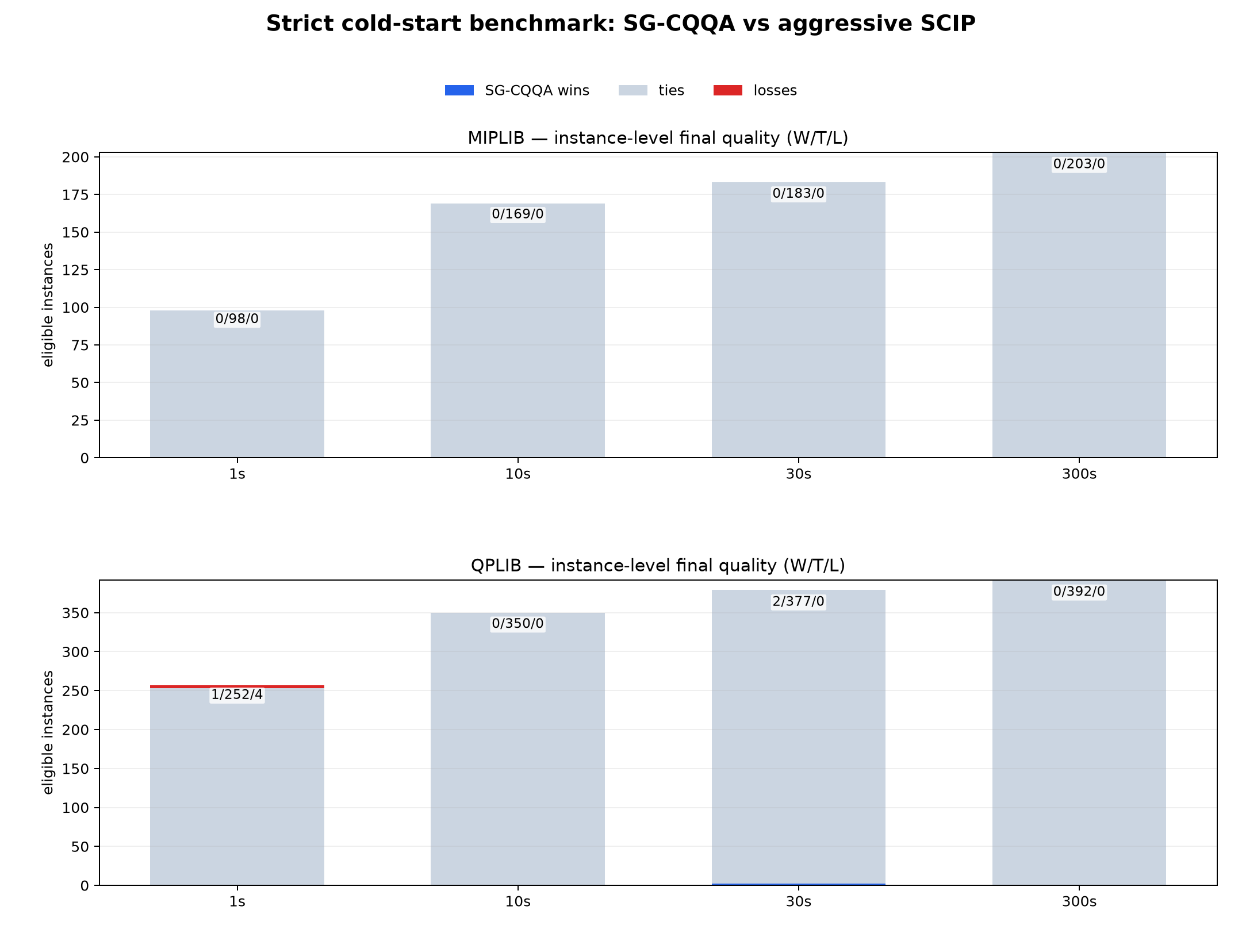
This sealed campaign evaluated all 240 MIPLIB 2017 benchmark instances and all 453 public QPLIB instances at 1, 10, 30, and 300 seconds, with five seeds and two independently executed solvers. It requested 27,720 runs, completed 26,501, retained 1,219 failures, and produced 19,360 feasible solution vectors that passed in-run original-model verification. The exact portable aggregate is available as JSON, with a separate validation report.
Coverage and QQA activity
| Library | Budget | Completed / requested | Failed | Paired seed runs | Feasible SCIP → SG-CQQA | QQA executed / directly improved |
|---|---|---|---|---|---|---|
| MIPLIB | 1 s | 2,400 / 2,400 | 0 | 1,200 | 470 → 467 | 0 / 0 |
| MIPLIB | 10 s | 2,400 / 2,400 | 0 | 1,200 | 790 → 790 | 0 / 0 |
| MIPLIB | 30 s | 2,392 / 2,400 | 8 | 1,196 | 870 → 870 | 0 / 0 |
| MIPLIB | 300 s | 2,362 / 2,400 | 38 | 1,179 | 976 → 975 | 5 / 1 |
| QPLIB | 1 s | 4,294 / 4,530 | 236 | 2,145 | 1,224 → 1,221 | 0 / 0 |
| QPLIB | 10 s | 4,235 / 4,530 | 295 | 2,117 | 1,666 → 1,666 | 0 / 0 |
| QPLIB | 30 s | 4,261 / 4,530 | 269 | 2,128 | 1,805 → 1,806 | 0 / 0 |
| QPLIB | 300 s | 4,157 / 4,530 | 373 | 2,077 | 1,883 → 1,881 | 0 / 0 |
Outcomes
W/T/L is always SG-CQQA versus aggressive SCIP. Final quality compares feasibility first and then the directional reference error or objective. Instance-level rows aggregate the five seeds before classification. The primal integral is the matched anytime metric; lower is better.
| Library | Budget | Final seed W/T/L | Final instance W/T/L | Integral instance W/T/L |
|---|---|---|---|---|
| MIPLIB | 1 s | 26 / 1,149 / 25 | 0 / 98 / 0 | 27 / 185 / 21 |
| MIPLIB | 10 s | 7 / 1,184 / 9 | 0 / 169 / 0 | 41 / 141 / 51 |
| MIPLIB | 30 s | 5 / 1,183 / 8 | 0 / 183 / 0 | 65 / 118 / 50 |
| MIPLIB | 300 s | 13 / 1,159 / 7 | 0 / 203 / 0 | 76 / 64 / 92 |
| QPLIB | 1 s | 62 / 2,019 / 64 | 1 / 252 / 4 | 91 / 261 / 71 |
| QPLIB | 10 s | 5 / 2,098 / 14 | 0 / 350 / 0 | 141 / 133 / 143 |
| QPLIB | 30 s | 20 / 2,097 / 11 | 2 / 377 / 0 | 161 / 104 / 155 |
| QPLIB | 300 s | 7 / 2,067 / 3 | 0 / 392 / 0 | 172 / 60 / 187 |
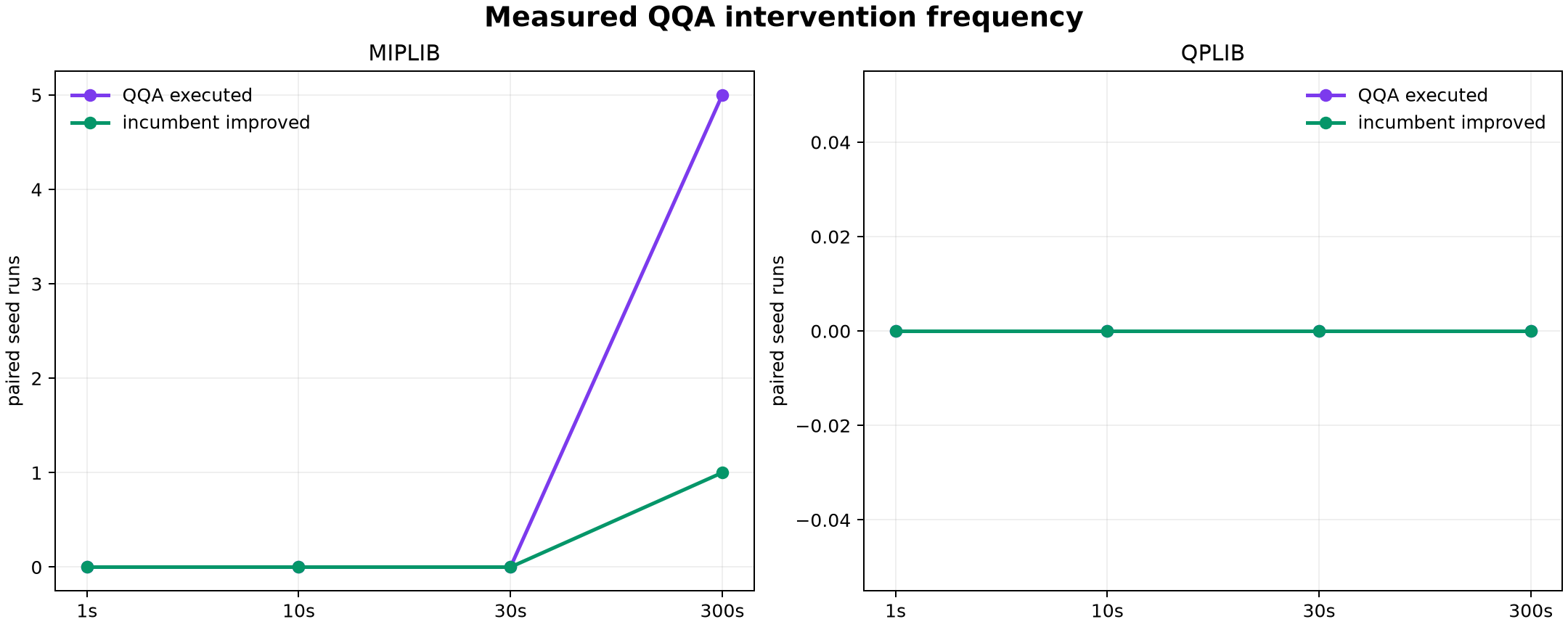
The conservative startup gate intentionally prevented QQA execution in every
1-, 10-, and 30-second cell. It also prevented numerical QQA calls on QPLIB at
300 seconds, although five runs registered the lightweight plugin. Those rows
measure the matched SCIP path and cold-process variability, not a QQA
advantage. On MIPLIB at 300 seconds, QQA executed on all five seeds of
gen-ip054: final-quality W/T/L was 2/2/1, primal-integral W/T/L was 2/0/3,
and one QQA candidate directly improved the incumbent. This is a narrow,
measured intervention benefit, not suite-wide or universal dominance over
SCIP. None of the instance-level primal-integral sign tests was significant at
5%; exact p-values are retained in the JSON.
Strict protocol and limitations
- Revision
f30b9f82b79dcf9bc09c9538c7e3e75a8567f8fbused one SCIP, LP, and Torch thread per run. Solver order was balanced by portable instance name and seed. - Every solver ran in a fresh isolated interpreter. The clock began before original-model import, and structurally bypassed SG-CQQA cells were executed independently rather than copied from the baseline.
- The selected hybrid used float64, four candidates, 16 replicas, 20 epochs, and a 5% measured callback-overhead cap. CPU was selected for these small screened cores; accelerator correctness was checked separately and is not presented as a runtime result.
- Original-coordinate vectors were retained for validation. The post-run validator checked each expected dimension, solution-hash presence, and recorded maximum infeasibility; domain, integrality, bound, and feasibility checks occurred against the original model in each isolated run. Published aggregates contain no machine name, scheduler identifier, account, private path, or command line.
- The native process cap includes a bounded shutdown and serialization grace. Consequently 3,968 completed cold-clock rows exceeded the nominal budget by more than 0.1 seconds, predominantly at the shortest budgets. These rows are retained, counted in the validation JSON, and not silently relabelled.
- The 1,219 unmeasured runs comprise bounded worker timeouts and isolated backend failures. They are excluded from paired W/T/L calculations. Longer QPLIB cells record more backend failures; their normalized classes remain machine-readable, but no failed cell is assigned to either solver.
The pre-registered settings and public snapshot hashes are shipped in
qqa/benchmarking/manifests/audit-public.toml. See the
reproduction guide for portable
fetch, shard, resume, merge, and publish commands.
Historical 2026-08-26 campaign
The following earlier campaign is retained without selecting only favourable instances. Full per-instance results and incumbent trajectories remain generated artifacts rather than repository-root data.
| Campaign identity | Value |
|---|---|
| Date | 2026-08-26 |
| Summary schema | 1 |
| Primary comparison | sg-cqqa vs scip-aggressive |
| Budget | 30 seconds per solver run |
| Historical seed count | 1 |
Protocol
- The primary comparison is
sg-cqqaagainst the matchedscip-aggressiveablation. Both use one SCIP/LP thread, seed 0, the same public instance, reference snapshot, and a 30-second total solver budget. - MIPLIB contains all 240 benchmark-set instances. QPLIB contains all 453
public instances. The campaign configuration recorded
cudafor MIPLIB andcpufor QPLIB. The pre-fix MIPLIB implementation did not forward that device field into the inner QQA solve, so its QQA calls actually used CPU; device forwarding is fixed for subsequent runs. This does not alter the recorded solution comparisons, but the campaign must not be used as a GPU runtime measurement. No machine, scheduler, host, or private path metadata is retained. - Final-quality W/T/L first compares feasibility and then directional reference error (or the original objective when no reference is available). Primal-integral W/T/L uses a common 30-second horizon; lower is better.
- QPLIB's sparse algebraic import is common preparation outside each paired solver clock. Solver-model construction, plugin setup, QQA, completion, and SCIP are inside the budget. Each native run is process-isolated.
- The QQA-only ablation sets
fast_candidates=0and permits 20% heuristic overhead. The primary hybrid uses two fast candidates, a continuous- completion escalation gate, and a 10% overhead cap.
Screened non-regression profile
A later conservative campaign added explicit structural bypasses, a 0.1%
minimum completion improvement, core-coverage gates, in-place dive completion,
and QPLIB PROBTYPE routing. Both suites use one solver/LP/Torch thread, seed
0, a 30-second budget, balanced execution
order, and scip-aggressive as the direct baseline.
The generated manifest intentionally omits implementation_revision because
the campaign was generated before that implementation had a commit identity.
The omission preserves provenance instead of assigning a later refactor SHA.
| Library | Requested instances | Successful pairs | Final W/T/L | Integral W/T/L | QQA-executed pairs |
|---|---|---|---|---|---|
| MIPLIB | 240 | 240 | 1 / 239 / 0 | 1 / 239 / 0 | 1 |
| QPLIB | 453 | 437 | 0 / 437 / 0 | 1 / 436 / 0 | 1 |
| Combined | 693 | 677 | 1 / 676 / 0 | 2 / 675 / 0 | 2 |
On the two pairs where QQA actually executed, final quality is 1/1/0 and
primal integral is 2/0/0. MIPLIB uses a 32-variable applicability gate and
QPLIB uses a 64-variable gate plus an explicit QML allow-list. Every other
successful pair is an exact reuse of the matched aggressive-SCIP baseline,
marked equivalent_baseline_reuse; those ties demonstrate suite-level
non-regression but are not evidence that QQA improved the instance. QPLIB has
the same 16 process-isolated failures for both solvers, so failures are not
counted as wins or losses.
Six-seed checks on the two active families recorded final-quality 1/5/0 for
gen-ip054 and 1/5/0 for QPLIB_0031. The anytime metric remained sensitive
to the heuristic cost. Increasing QPLIB completion from 0.25 to 1 second was
rejected: its six-seed final result was 1/4/1 despite a stronger local
incumbent on the losing seed. These results support the short, selective
profile; they do not establish universal dominance over SCIP on arbitrary
instances, seeds, or time limits.
Earlier broad primary full-suite comparison
| Library | Paired instances | Feasible baseline → SG-CQQA | Final W/T/L | Integral W/T/L | Median primal error baseline → SG-CQQA | Median integral baseline → SG-CQQA |
|---|---|---|---|---|---|---|
| MIPLIB | 240/240 | 177 → 177 | 6 / 194 / 40 | 12 / 116 / 112 | 0.07450 → 0.08511 | 25.573 → 26.875 |
| QPLIB | 437/453 | 348 → 351 | 43 / 361 / 33 | 145 / 133 / 159 | 0.06129 → 0.07407 | 14.669 → 14.144 |
On QPLIB's 437 successfully paired instances, the primary hybrid has more final-quality wins than losses (43 versus 33), finds three additional feasible solutions, and lowers the median primal integral. It does not dominate every anytime comparison: integral wins/losses are 145/159, and its median final reference error is higher.
On MIPLIB, the 30-second primary hybrid is weaker than aggressive SCIP: six final wins versus 40 losses, with equal feasible counts. This negative result is retained in full. The primary MIPLIB candidate path generated 631 candidates; 47.70% completed feasibly, 44.37% were accepted, and 6.97% improved the original incumbent. The QQA subset generated 175 candidates with 76.57% completion, 70.29% acceptance, and 2.86% incumbent improvement.
For QPLIB, the primary path generated 489 candidates with 39.47% feasible completion, 38.85% acceptance, and 14.72% incumbent improvement. Its 63 QQA candidates had 46.03% completion, 44.44% acceptance, and 3.17% incumbent improvement.
QQA-only ablation
| Library | Paired instances | Paired feasible baseline → SG-CQQA | Final W/T/L | Integral W/T/L | QQA acceptance | QQA incumbent improvement |
|---|---|---|---|---|---|---|
| MIPLIB | 240/240 | 177 → 177 | 4 / 191 / 45 | 6 / 115 / 119 | 43.51% | 7.42% |
| QPLIB | 437/453 | 350 → 350 | 23 / 361 / 53 | 97 / 135 / 205 | 36.09% | 10.06% |
QQA-only loses more often than the gated primary hybrid on both libraries. The result supports using QQA conditionally inside SCIP, with cheap surrogate candidates and completion evidence, rather than invoking it as an unconditional replacement for native primal heuristics.
Additional diagnostics
The five-second CPU MIPLIB screening compares plain SCIP, aggressive SCIP, and the primary hybrid on all 240 instances. Against aggressive SCIP, SG-CQQA records 8/226/6 final W/T/L but 13/166/61 primal-integral W/T/L; feasible counts are 139 versus 138. The configured minimum QQA reserve prevents QQA calls at this short horizon, so this is a fast-surrogate screening result, not evidence for the learned QQA path.
A two-instance QPLIB diagnostic uses three seeds on one binary QBL and one
mixed-binary/continuous QML instance. Across six pairs, SG-CQQA records
4/0/2 for both final quality and primal integral. This small, previously
explored diagnostic is published for seed sensitivity only and is not used as
an estimate of full-library performance.
Failures and limits
All requested runs were attempted. MIPLIB completed 480/480 primary and 480/480 QQA-only runs without failure. In the QPLIB primary campaign, 874/906 runs completed and 32 anonymous failures covered the same 16 instances for both solvers: 28 bounded worker timeouts and four native-process failures. The QQA-only campaign completed 875/906 runs with 31 failures: 28 worker timeouts and three native-process failures. Consequently 437/453 QPLIB instances have direct paired measurements in each campaign.
These failures are not counted as wins or losses. They are preserved by basename, solver, seed, and error class in the artifacts. Native isolation keeps a failed nonlinear or exceptionally large model from terminating the remaining campaign; it does not turn an unmeasured run into a result.
The benchmark establishes a QPLIB final-quality advantage for this fixed 30-second primary campaign, but not universal superiority. In particular, MIPLIB and the QQA-only ablations remain negative, one seed is insufficient for a broad stochastic claim, and longer budgets may change the ranking.
Snapshot identity
- MIPLIB 2017 benchmark-v2 archive:
c756eefd544d83b31809306b45d3549a1a5b9378e6aa78b68738b1a3b6a418fa - MIPLIB solution snapshot v36:
9236602294c1a5aca5248b6f7d03689a7533ea3cbf3f3d92cff962e752e20af84 - QPLIB public archive:
b3596e1264ed57c5f6a44e822679f5c9138e1985fe74bc8341c3becbc666b9fd - QPLIB solution snapshot:
6e024cd786b3049e572a96fbe89ddd0d73ff4d6bcac0c0427e9086d378dc0c43
The snapshots were retrieved from the official public sources on 2026-08-25 (UTC). See the MIPLIB download page, MIPLIB benchmark set, QPLIB instances, and QPLIB format documentation.